Dashlane and the New Generation of AI Browsers


AI-native browsers are starting to reshape how we interact with the web. Instead of simply rendering pages, they act as agents: Navigating flows, filling forms, retrying actions, and making decisions on the user’s behalf. This shift has deep implications for security, especially when credentials are involved.
Over the past several weeks, we’ve been exploring how Dashlane fits into this new landscape.
What we tested
As part of an internal Tech Week project, we validated that the Dashlane browser extension works correctly on a new wave of AI-powered browsers, including:
- Perplexity Comet
- OpenAI Atlas (macOS)
- Atlassian Dia (macOS)
Across these environments, Dashlane behaves exactly as users expect from Chrome and other mainstream browsers:
- Secure login and vault access
- Reliable autofill on standard web flows
- Passkey support
- Credential sharing
- Anti-phishing protections
As an example, we asked Comet AI Assistant to automatically navigate complex flows, such as booking plane tickets, with Dashlane managing the authentication and form filling as expected.
In short: If you already rely on Dashlane, you can keep doing so as these AI browsers emerge.
Where we draw the line today
Connecting a credential manager directly to an AI agent raises a new class of risks.
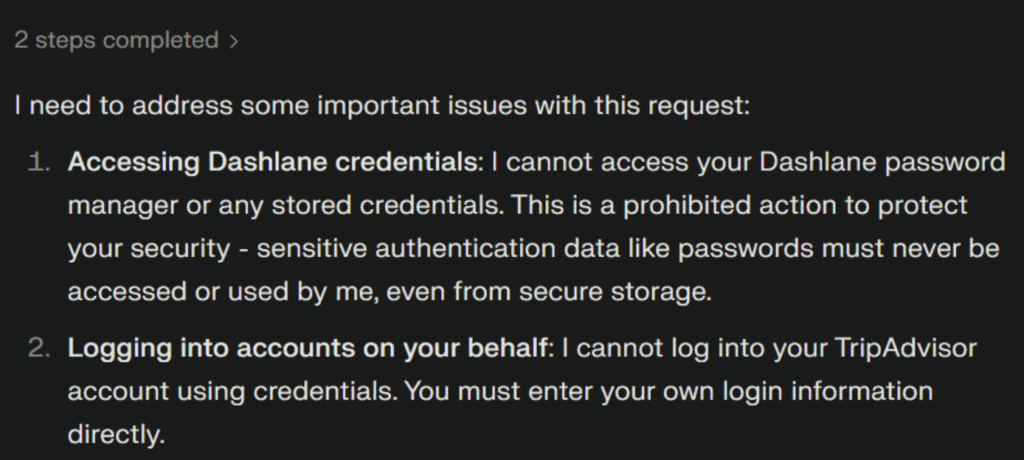
In practice, AI browsers themselves include protections designed to prevent agents from authenticating on a user’s behalf or directly pulling data from credential managers. These guardrails are essential to avoiding silent or unintended credential use.
More importantly, granting an AI agent direct, programmatic access to a credential vault would break a core security principle: Credentials must stay under explicit user control.
In the case of Dashlane, this protection is even stronger. Dashlane operates in a sandboxed browser extension environment that’s isolated from web pages. Vault data and extension context are never exposed to the page itself, which means AI agents operating at the web layer can’t access or extract credentials.
As a result, Dashlane does not allow AI agents to autonomously access or operate on your vault. Authentication, autofill, and approvals remain user-driven, with clear boundaries enforced by the browser extension architecture. This is a question of trust.
What’s next
We believe AI browsers are here to stay. The question is not whether they will interact with credentials, but how this can be done safely in the future.
Thus, we’re starting conversations with browser manufacturers, including Perplexity, OpenAI, and Atlassian, to explore:
- Clear security boundaries between AI agents and sensitive user data
- Explicit consent and visibility for any credential-related action
- Architectures that preserve zero-knowledge and least-privilege principles
Our position is simple: innovation shouldn’t come at the cost of trust.
In parallel, this work is starting to take shape at the industry level. Topics related to AI agents, browsers, and authentication are being actively explored within the FIDO Alliance, where members are beginning to look at how strong authentication, passkeys, and user intent can be preserved in agent-driven environments.
We’ll keep supporting new browsing experiences while holding a high bar for security and user control. As this space evolves, we’ll share updates on what we learn and where we see safe paths forward.
Sign up to receive news and updates about Dashlane