AI Is the New Co-Worker Employees Trust. That’s The Problem.

Increasingly, AI works alongside employees like a co-worker would. AI assistants draft emails, copilots sit inside the apps employees open every day, and agents log in to systems on their behalf.
Along the way, employees started trusting AI like a coworker too. When Dashlane surveyed 3,000 employees and 800 IT and security leaders across the U.S., the U.K., and France, 48% of employees said they'd lend their login credentials to an AI tool they'd used for a week, compared to 42% who would do the same for a new human co-worker.
That 6-point gap is a window into how employees think about AI and why IT and security teams keep finding out about AI risk after the fact.
Here’s a brief look at some key findings from our new report, Misplaced Trust: Inside the Workplace’s New AI Security Blind Spot, including what security executives say their employees are doing with AI compared to what they’re actually doing.
Why employees trust AI like a co-worker
Working with AI feels like a conversation, so employees default to the social habits they'd use with a colleague. For example, nearly half (46%) regularly say "please" and "thank you" to AI.
But courtesy often comes with trust, and trust changes what people share. More than half of employees have done something with AI they wouldn't do with a co-worker, a website, or another work system:
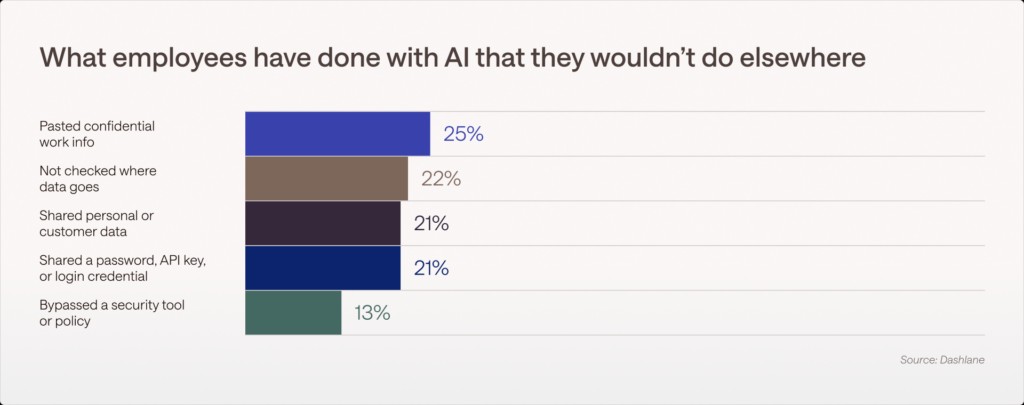
In other words, employees give AI the benefit of the doubt they'd normally reserve for people they know well, without the track record to back it up.
How many employees share credentials with AI agents
For many employees, their trust in AI extends to their most sensitive information. About 1 in 5 (21%) admit to sharing a password, API key, or login credential with an AI tool or agent. Once those credentials go in, employees have little say over where they're stored or who can reach them.
The bigger risk is how normal it feels. More than half of employees (52%) say they'd comply if AI asked them to confirm their login credentials every day. That's an opening attackers are built to exploit. Impersonate an AI tool, or use prompt injection to make a legitimate agent ask for a login, and a routine request turns into an entry point.
AI isn't just holding credentials, either. More than half of employees (55%) let AI act on their behalf without asking first. Some of that is everyday work, like reading and sending email. Some of it carries real business consequences, and the full report shows just how far that autonomy goes.
Once AI gets access, it tends to keep it. About 1 in 5 employees have given AI access they later learned it shouldn't have had, and nearly half of those say that access is still active.
Why IT and security leaders can’t see AI agents
IT and security leaders aren't naive about AI risk, but they’re being outpaced by it. Ninety-three percent feel pressure from company leadership to adopt AI, and 53% say AI tools have been deployed before a security review.
Meanwhile, AI keeps arriving through side doors. More than a quarter of employees (28%) admit they use AI tools their employer doesn't know about.
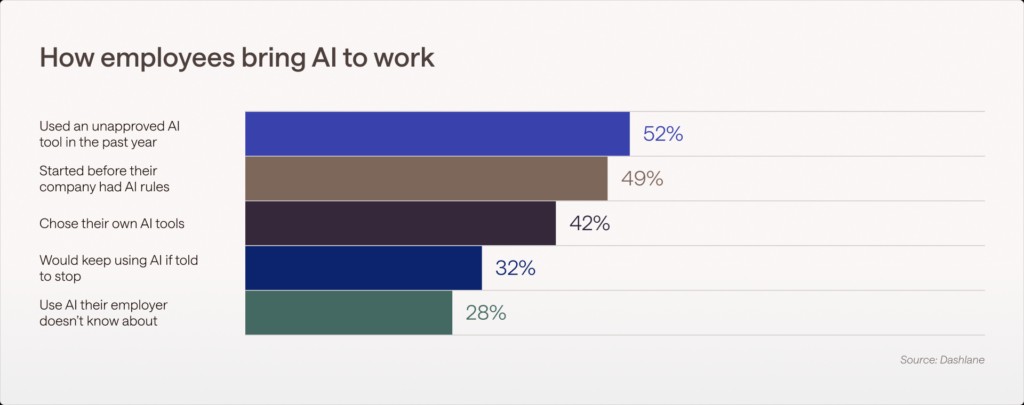
While most security leaders (89%) are confident they know about every AI agent in use, 98% of organizations have discovered agents only after they were already deployed. Confidence and visibility, it turns out, aren't the same thing.
AI agent security incidents: What the data shows
This isn't a future problem. In the past 12 months, 72% of organizations have had a security incident involving an AI agent's credentials or access.
Part of what makes these incidents hard to catch is how agents get access in the first place. Many run on credentials shared or inherited from employees, so in the logs, an agent's actions can look similar to a person's. That makes excess permissions harder to spot and incidents harder to contain.
And those are only the incidents security teams know about. More than half of security leaders (54%) aren't fully confident they'd hear about every AI-related incident in their organization.
How to set boundaries for AI agent access
Employees have already decided to trust AI, and that won't be reversed by another email about policy.
The problem is that most systems offer only one way to extend trust. To let an AI agent handle one task, an employee hands over a login that opens everything that login can reach, for as long as the agent holds it.
Most of this happens in the browser—where employees paste data, share logins, and connect AI tools—so that's where the limits have to be for every employee. The question for security leaders is how much access that trust should come with, and how to enforce the limits when employees work around the rules.
In the full report, we break down four practical moves IT and security teams can make now. You'll also find:
- An industry spotlight: Why one of the most regulated sectors shows some of the riskiest AI habits
- Country comparisons: Where the U.S., the U.K., and France diverge on AI agent access, incidents, and priorities
- The accountability question: Who security leaders expect to take the blame when an AI incident hits
Download the full Misplaced AI Trust Report to see what 3,800 workers and security leaders told us, and where to draw the line on AI trust.
Frequently asked questions
Do employees share passwords with AI?
Yes. About 1 in 5 employees (21%) admit to sharing a password, API key, or login credential with an AI tool or agent. Once those credentials go in, employees have little say over where they’re stored or who can reach them.
What is an AI agent credential?
An AI agent credential is a login, password, API key, or other access token that lets an AI agent sign in to systems and act on someone’s behalf. Many agents run on credentials shared or inherited from employees, so an agent’s actions can look similar to a person’s in the logs.
Why are AI agents a credential risk?
When an employee hands an agent a login, it opens everything that login can reach, for as long as the agent holds it. In the survey, 72% of IT and security leaders reported a security incident involving an AI agent’s credentials or access in the past 12 months.
How can IT limit AI agent access?
Start by finding every AI agent in use, since 98% of IT and security leaders surveyed said their organizations have discovered agents only after deployment. Then set limits where employees paste data, share logins, and connect AI tools, which is mostly in the browser.
Sign up to receive news and updates about Dashlane